
Z31 More Fuel: Fuel Pressure and FMU
Once a Z31 Turbo makes more boost than stock, especially with a larger turbo, the stock fuel system runs out. There are two ways to get more fuel: push more through the stock injectors with higher fuel pressure, or fit larger injectors and retune the ECU’s K value (covered on the ECU tuning page).
How Fuel Pressure Raises Injector Flow
An injector’s flow rating is at a given fuel pressure. Raise the pressure and it flows more. Flow rises with the square root of the pressure change:
Stock Z31 Turbo injectors are about 260 cc/min at roughly 37 psi.
At 60 psi: √(60 ÷ 37) × 260 ≈ 1.273 × 260 ≈ 331 cc/min
At 80 psi: √(80 ÷ 37) × 260 ≈ 382 cc/min
- Boost adds to base fuel pressure, so 60 psi base at 18 psi boost is 78 psi total.
- The limit is the pump: as pressure rises, its flow falls. On this car, an upgraded high-pressure 255 lph pump managed almost 85 psi with the stock injectors when pushed to its limit. See the fuel pump upgrade.
- After raising pressure, recalculate K for the injectors’ new effective size (see ECU tuning). Raising TTP max also lifts the ECU’s duty cycle limit.
- Running injectors near 100% duty gives another 15–20%, but they get very hot. Not recommended.
The Fuel Management Unit (FMU)
A stock regulator raises fuel pressure 1:1 with boost. An FMU raises it faster than that under boost, so the stock injectors flow more without a higher base pressure. It’s a legitimate way past the roughly 260 rwhp limit of the fully stock fuel system.
FMUs get blamed for burned-out pumps and injectors, but the problem is usually the wrong unit or setup:
- Pumps shouldn’t run at or near their internal relief valve pressure. Pump output becomes erratic there under load.
- Most injectors work correctly up to about 125 psi, but pump flow falls off long before that. Even good high-pressure pumps struggle to flow much past 90 psi.
- A fixed 12:1 FMU adds about 12 psi of fuel pressure for every psi of boost. From 37 psi base, that’s about 85 psi at only 4 psi of boost and nearly 100 psi at 5. Far too much, and the Z31 ECU doesn’t need it.
- Better units have adjustable onset (the boost where extra pressure starts) and an adjustable rate of gain.
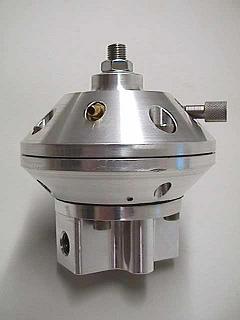
Setting one up
- On the unit used here, even with onset fully in, pressure started rising above 1:1 at about 6 psi of boost. Around 10–11 psi, where a bigger turbo starts to go lean, would have been better. A bleeder or check valve in the FMU’s signal line (the same as a manual boost controller) can delay onset.
- Once onset is set, the rate adjustment works much like an AFR screw. It can’t fix richness at high boost and low rpm, because the FMU knows nothing about airflow.
- Tune with a wideband. Mount a fuel pressure gauge where you can see it from the driver’s seat, so you can tell when the pump starts to fall off or its relief valve opens.
Limits you’ll hit at higher boost
- Pump flow runs out. High-pressure pumps reportedly won’t handle much over 90 psi (about 100 psi shimmed).
- Injectors are likely to lock up above about 100 psi of fuel pressure.
- The stock MAF and ECU programming are maxed out, so the timing maps are off. Watch for detonation at upper rpm. This car needed almost 5 degrees of base timing taken out to run 15 psi without detonation.
Set up this way, the car ran 16 psi, with the pump giving out at about 18 psi of boost. Based on a later dyno at the same boost, that’s around 320–330 rwhp. With an ECU retune (raised TTP max and adjusted fuel maps), 350+ rwhp from the otherwise stock fuel system looks possible.
Wideband Logs: With and Without the FMU
These pulls are from the same car with an upgraded turbo and the stock fuel system, run with about 10 degrees of timing pulled to stay clear of detonation.


12.5:1 is still leaner than many people run under boost, but far safer than the stock system at 13 psi.
Larger Injectors Instead
Past what the stock injectors and pump can supply, larger injectors are the next step. They need a new K value, TP scales, TTP min and injector latency in the ECU. The ECU tuning page shows how to estimate K from the injector size and then find it with a wideband, and lists the ROM addresses.
Related
- ECU Tuning: K Value, ROM Table, Nistune and MicroSquirt
- MAF Upgrade
- Fuel Pump Upgrade
- DSM Injectors
- Nistune
- Bigger Turbo Upgrade
Credits
- Originally written by Jason Butts (Jason84NA2T) for redz31.net, with his wideband logs. Rewritten for XenonZcar.