
Z32 Clutch Master and Slave Cylinder Failure
You press the clutch and the pedal stays on the floor, or it comes back up slowly and the car won't go into gear. On a Z32 300ZX this almost always means the clutch hydraulics have lost fluid or pressure, and the usual cause is a worn clutch master cylinder or slave cylinder (Nissan calls the slave the operating cylinder). Both are cheap parts and the repair is well within reach at home.
- Difficulty
- 2 of 5 (slave), 3 of 5 (master)
- Time
- 1 to 3 hours
- Fluid
- DOT 3 brake fluid
- Helper
- Needed for bleeding
Symptoms
- The pedal sticks to the floor or comes back up slowly. This is the classic sign of a master or slave cylinder seal letting fluid past.
- A soft, spongy or low pedal that only releases the clutch at the very bottom of its travel. Air in the system or a tired master cylinder seal.
- Hard shifting or grinding, especially into first and reverse, because the clutch never fully lets go.
- The pedal works after a few pumps but fades again. A master cylinder seal that bypasses internally does this, often with no visible leak.
- The clutch reservoir level keeps dropping. The fluid is going somewhere: look at the slave cylinder, the lines and the firewall.
- Wet carpet or fluid on the back of the master cylinder, on the firewall or down the pedal arm in the footwell.
- A heavy pedal on a twin turbo car (pedal still releases the clutch, but takes much more effort). That points to the vacuum side of the clutch booster, not the hydraulics. See TT clutch booster below.
The clutch reservoir sits next to the brake reservoir, and on the Z32 it shares fluid type with the brakes. A low clutch reservoir is not normal wear the way a slowly falling brake level can be, because the clutch has no pads to wear. If it's dropping, there's a leak.
How the Z32 System Works
Pressing the pedal pushes a rod into the clutch master cylinder on the firewall. The master cylinder pushes fluid through a steel line down to a clutch piping connector (a junction block you can reach from the engine bay), then through a short flexible hose to the operating (slave) cylinder bolted to the side of the bell housing. The slave pushes the withdrawal lever, which moves the release bearing and frees the clutch.
There are two air bleeder screws: one on the slave cylinder and one on the piping connector. Bleeding only the slave, as you would on many other cars, often leaves air trapped at the connector.
The non-turbo (VG30DE) and twin turbo (VG30DETT) cars differ at the pedal end:
- VG30DE (non-turbo): the pedal pushes the master cylinder directly.
- VG30DETT (twin turbo): a vacuum clutch booster sits between the pedal and the master cylinder to lighten the heavier TT clutch. It's fed by a hose from the intake manifold through a one-way check valve and a vacuum tank. A cracked hose, failed check valve or leaking booster gives a heavy pedal, but the clutch still releases.
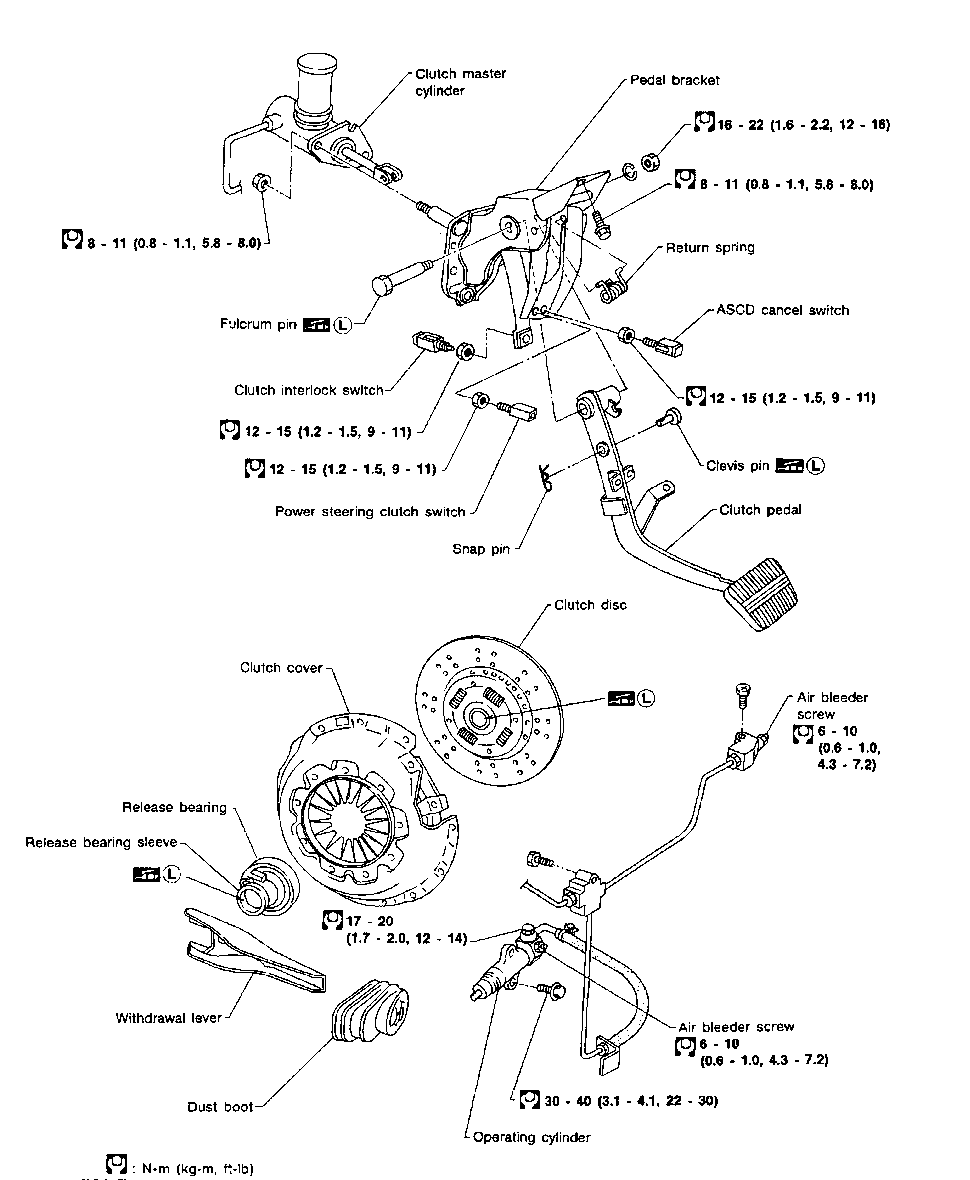
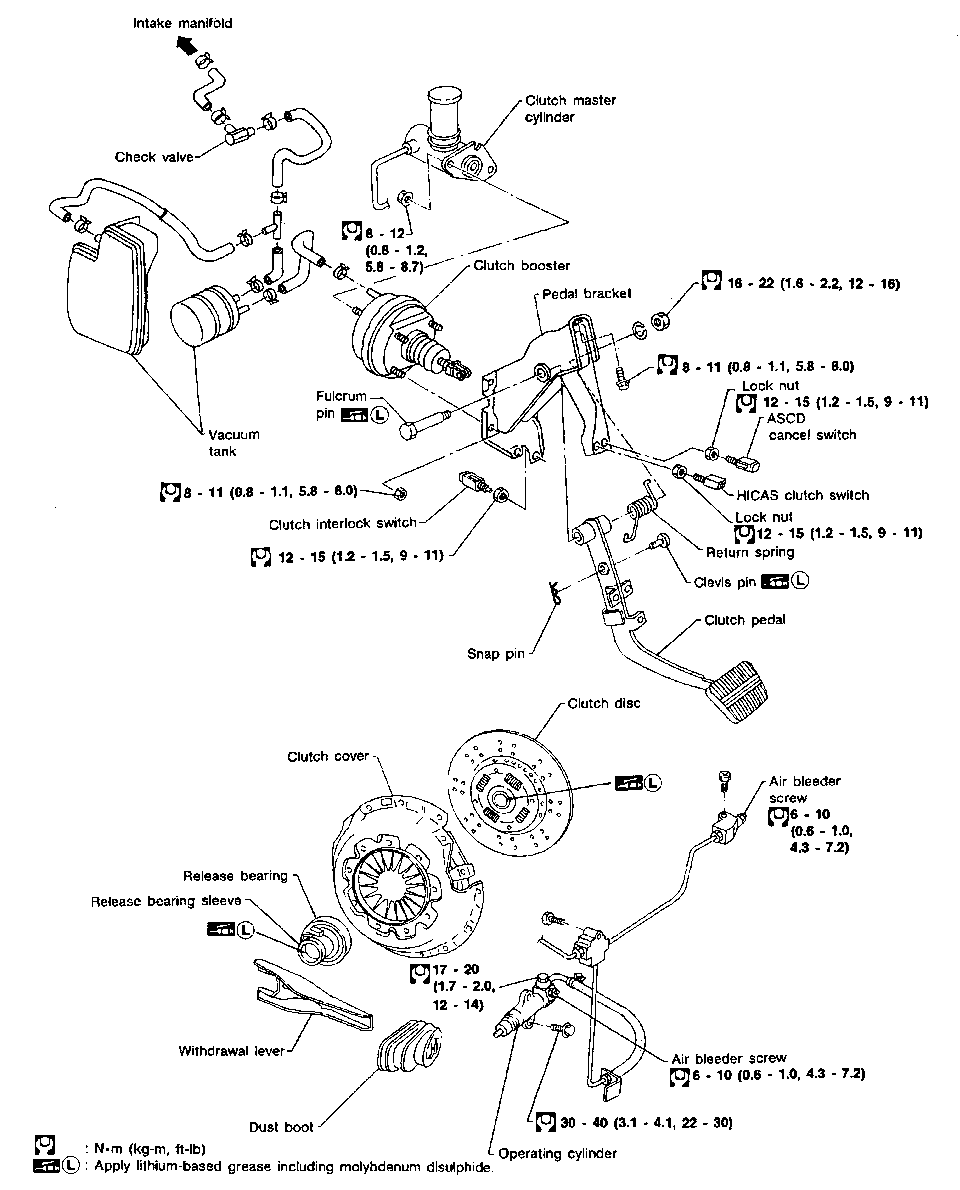
Finding the Fault
- Check the reservoir. If it's low or empty, the system has leaked or the fluid has been pulled into the master cylinder's failed seal. Dark, dirty fluid is a sign the seals are wearing.
- Look at the master cylinder. It's bolted to the firewall next to the brake master. Wipe it clean and check where it meets the firewall, then look up under the dash at the pushrod and the top of the pedal arm. Fluid there means the master's rear seal has failed.
- Look at the slave cylinder. From under the car, find the operating cylinder on the side of the bell housing. Gently pull back the rubber dust boot. A few drops is the start of a failure; a boot full of fluid means the slave has failed.
- Check the lines. Follow the steel line from the master to the piping connector and the flexible hose to the slave. Look for wet fittings, a weeping bleeder screw, and a cracked or swollen hose.
- No leak anywhere but the pedal still sinks? The master cylinder is bypassing internally: fluid slips past the piston seal inside the bore. Replace the master.
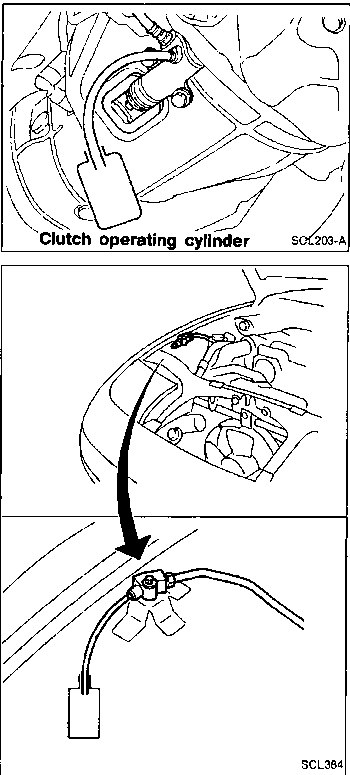
Replacing the Cylinders
The master and slave are the same age and wear together, so when one fails it's worth replacing both. Flush in fresh fluid at the same time. Both cylinders can also be rebuilt with seal kits if the bores are clean, but on a car this age the bores are often pitted or rusty, and a new cylinder costs little more than a kit.
Brake fluid strips paint. Cover the fender and anything below the master cylinder with rags, and rinse off spills with water straight away. Never reuse drained fluid, and never put mineral oil (power steering fluid, ATF, engine oil) in the system: it ruins the rubber seals.
Slave (operating) cylinder
- Raise the car and support it on jack stands.
- Remove the hose eye bolt from the slave cylinder. Catch the fluid and keep the two sealing washers out of the way; use new washers on reassembly.
- Remove the mounting bolts and pull the slave cylinder off the bell housing.
- Fit the new cylinder, making sure the pushrod seats in the withdrawal lever. Torque the mounting bolts to 30–40 N·m (22–30 ft·lb) and the eye bolt to 17–20 N·m (12–14 ft·lb).
- Bleed the system (below).
Master cylinder
- Draw as much fluid out of the clutch reservoir as you can with a syringe or turkey baster.
- Disconnect the steel line from the master cylinder with a flare nut (line) wrench. An open-end wrench will round the fitting.
- Under the dash, remove the snap pin and clevis pin that join the master's pushrod to the pedal.
- Remove the two nuts holding the master cylinder to the firewall (on a TT, to the booster) and lift it out.
- Fit the new master and torque its nuts to 8–11 N·m (5.8–8.0 ft·lb) on the NA, or 8–12 N·m (5.8–8.7 ft·lb) on the TT. Grease the clevis pin, refit it, and check the pedal free play (below).
- Reconnect the line, fill the reservoir and bleed the system.
Bench bleed a new master before you fit it, if you can: clamp it in a vise, fill it, and push the piston in with a screwdriver until fluid comes out with no bubbles. It makes the bleeding on the car much quicker.
Bleeding the Clutch
You'll need a helper, a clear plastic tube that fits snugly over the bleeder screws, a catch bottle and fresh DOT 3 fluid. The factory order is the slave cylinder first, then the piping connector.
- Fill the clutch reservoir. Keep an eye on it throughout: if it runs dry you'll pull air back in and have to start again.
- Push the tube onto the slave cylinder's bleeder screw and put the other end in the bottle, below some fluid.
- Have your helper pump the pedal several times, then hold it to the floor.
- Open the bleeder about a quarter turn, let the fluid and air out, then close it before your helper lets the pedal up.
- Repeat until the fluid in the tube comes out with no bubbles.
- Move the tube to the bleeder on the clutch piping connector and do the same.
- Go back and forth between the two bleeders a few times until neither shows any air. Tighten the bleeders to 6–10 N·m (4.3–7.2 ft·lb). They're small and snap easily.
- Top up the reservoir and check that the pedal comes back up on its own and releases the clutch well off the floor.
A stubborn pedal can sometimes be fixed by leaving it overnight with the reservoir full and the cap loose, letting small bubbles rise to the top, then bleeding again.
Pedal Height and Free Play
Once the hydraulics work, check the pedal adjustment. It's set at the factory and rarely changes, but it can be disturbed when the master cylinder is replaced.
- Pedal height (H), measured square from the dash lower panel to the face of the pedal pad: 197–207 mm (7.76–8.15 in) on the VG30DE and 183–193 mm (7.20–7.60 in) on the VG30DETT. It's set by the stop switches at the top of the pedal (the ASCD cancel switch and the power steering clutch switch on the NA, or the HICAS clutch switch on the TT). Lock nuts 12–15 N·m.
- Free play, measured at the pedal pad before you feel the master cylinder start to push: 1.0–3.0 mm. Adjust it by turning the master cylinder pushrod, then tighten its lock nut. With the play set, the clevis pin should turn freely by hand; if it binds, the pushrod is too long and can hold the master cylinder partly on, which keeps the clutch from fully engaging.
- Clutch interlock switch (US cars, stops the engine starting unless the pedal is down): 1.0–2.0 mm clearance with the pedal fully pressed.
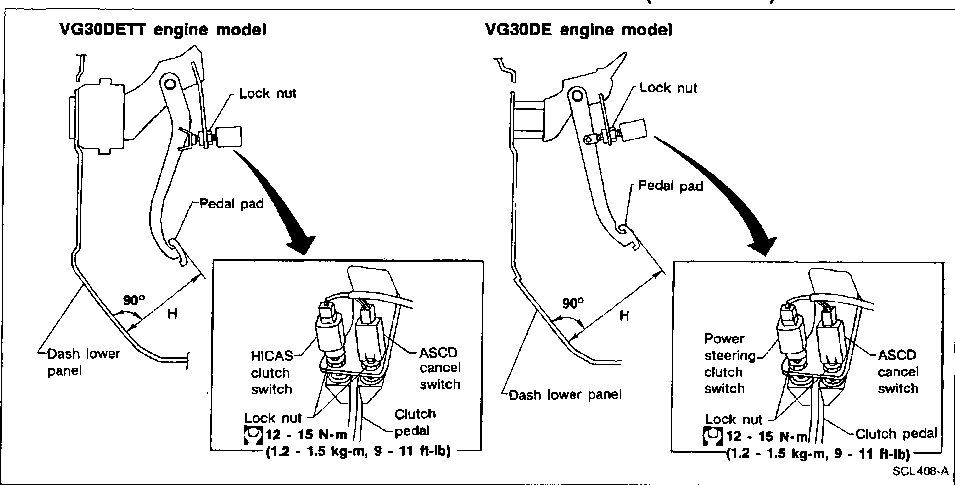
TT clutch booster checks
If a twin turbo pedal is heavy but the clutch releases, check the vacuum side before you blame the hydraulics:
- Look over every vacuum hose from the intake manifold to the check valve, vacuum tank and booster for cracks and loose ends.
- The check valve should pass air one way only: toward the manifold. Blow through it both ways; if it passes both, replace it.
- With the engine off, press the pedal several times to use up the vacuum, hold it down, and start the engine. The pedal should drop slightly as vacuum builds. If it doesn't, and the hoses and valve are good, the booster diaphragm is likely torn.
Specs at a Glance
| Item | Spec |
|---|---|
| Fluid | DOT 3 |
| Master cylinder bore | 15.87 mm (5/8 in) |
| Operating (slave) cylinder bore | 19.05 mm (3/4 in) |
| Bleeder screws | 6–10 N·m (4.3–7.2 ft·lb) |
| Slave cylinder mounting bolts | 30–40 N·m (22–30 ft·lb) |
| Clutch hose eye bolt | 17–20 N·m (12–14 ft·lb) |
| Master cylinder nuts | 8–11 N·m (5.8–8.0 ft·lb) NA; 8–12 N·m (5.8–8.7 ft·lb) TT |
| Pedal bracket nuts | 16–22 N·m (12–16 ft·lb) |
| Pedal switch lock nuts | 12–15 N·m (9–11 ft·lb) |
| Pedal height H, VG30DE | 197–207 mm (7.76–8.15 in) |
| Pedal height H, VG30DETT | 183–193 mm (7.20–7.60 in) |
| Pedal free play | 1.0–3.0 mm |
| Interlock switch clearance | 1.0–2.0 mm |
Sources Used
- Nissan 1994 300ZX service manual, Clutch (CL) section: system diagrams, bleeding order, adjustments and torque specs. Read the CL section
- Diagnosis and repair notes adapted from our Z31 clutch hydraulics guide; the two cars' systems work the same way.