
Z32 Crank Angle Sensor (CAS) Problems
The Z32 has no distributor. Its job is done by the crank angle sensor (CAS), which Nissan's manual calls the camshaft position sensor. It tells the ECU how fast the engine is turning and where each piston is, and the ECU uses that to time every spark and every injector pulse. When the CAS signal drops out, the engine stops instantly: no spark and no fuel. That makes it one of the classic Z32 “died while driving and won't restart” faults.
- Trouble code
- 11
- Location
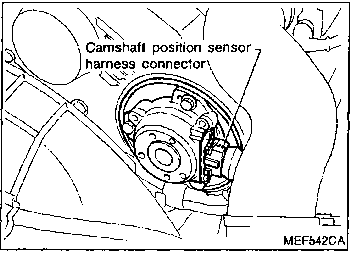
- Front of the left (driver's) cylinder head
- Base timing
- 15° ± 2° BTDC
- Signal
- 0–5 V pulses
Symptoms
- Cuts out when hot. The engine dies once it's fully warm, often in traffic or after a long drive, as if the key had been turned off.
- Won't restart until it cools down. It cranks normally but won't fire. After 15 to 30 minutes it starts and runs fine, until the next time. This pattern is the giveaway.
- The episodes get closer together until one day it won't start at all.
- No spark and no injector pulse on a cranking engine. With a dead CAS, all six cylinders lose both at once.
- Stumbling or a brief cut-out over bumps points to a loose connector or a broken wire at the sensor rather than the sensor itself.
- Code 11 stored in the ECU. Don't rely on it: an intermittent fault often leaves no code, and a code can clear once the engine restarts.
A hot cut-out that clears when the engine cools can also be a failing power transistor, ignition relay or fuel pump. The tests below tell them apart before you spend money on a sensor.
How It Works
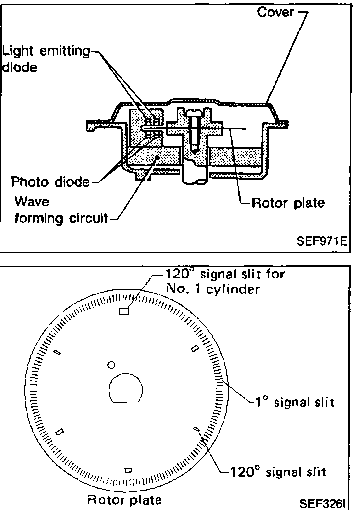
The CAS bolts to the front of the left cylinder head and is turned by the exhaust camshaft. Inside is a thin rotor plate with two rings of slits: 360 slits that give a pulse for every degree of rotation, and 6 larger slits that give a reference pulse every 120°, one per cylinder, with a different shaped slit marking cylinder No. 1. Light-emitting diodes shine through the slits onto photo diodes, and a small circuit board turns the flicker into clean on-off pulses for the ECU.
What Goes Wrong
- The electronics fail with heat. The sensor sits on a hot cylinder head, and after decades of heat cycles the circuit board, LEDs or solder joints start to fail when hot and recover when cool. This is the most common failure, and the fix is a replacement sensor.
- Oil gets in. The CAS seals to the head with an O-ring. When it hardens, oil seeps out around the sensor and can work its way inside, fogging the rotor and optics. An oily CAS is worth a new O-ring before it becomes a bad sensor.
- The connector and wiring. A dirty, corroded or loose connector, or wires cracked from heat near the plug, can cut the signal, especially over bumps. Always check these first; it's the cheapest fix.
- Timing knocked out. The CAS's position sets the ignition timing. If it has been removed and refitted without marking it, or its bolts have come loose, the engine will run badly or not at all.
Testing
- Read the codes. Code 11 points to the CAS circuit. Write the codes down, clear them, and see what comes back after the next failure.
- Check the connector. Unplug it, look for corrosion, bent pins and cracked wires, clean it, and plug it back in firmly. Wiggle the harness with the engine idling: if it stumbles, you've found it.
- Check power and ground. With the connector unplugged and the ignition on, the power terminal should show battery voltage (it's fed through the ECCS relay). With the ignition off, the ground terminal should have continuity to the engine ground.
- Check the signal. Nissan's bench test: remove the CAS from the engine but leave it plugged in, turn the ignition on, and slowly turn the shaft by hand. The voltage on each signal terminal should switch between 0 and 5 V. If either one doesn't, the sensor is bad. With a CONSULT, the data monitor shows CMPS·RPM (POS) and (REF), and both should match the idle speed.
- Catch it when it fails. When the engine has cut out hot and won't restart, check for spark and injector pulse right away. If both are missing, cooling just the CAS (with a cold wet rag or a can of freeze spray) and having it start straight away is a strong sign the sensor is the problem.
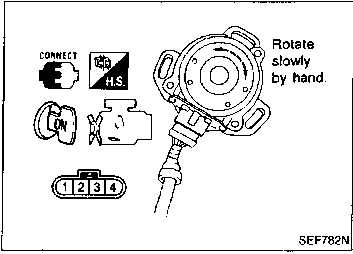
The manual warns that this test can store a code 11 even when the sensor is good, so clear the codes afterwards. The same turn-by-hand trick is used to click-test the injectors; disable the fuel pump first if you do it.
Replacing the CAS
- Disconnect the battery.
- Mark the sensor's position against the cylinder head with a paint pen or scribe, across both the sensor body and the head. This gets the timing close when the new one goes in.
- Unplug the connector, remove the mounting bolts and pull the sensor straight out.
- Clean the bore in the head. Fit a new O-ring to the sensor, lightly oiled, and check it's in its groove and not rolled or pinched.
- Line up the sensor's drive with the slot in the camshaft, push it home, and turn the body to your marks. Snug the bolts.
- Reconnect the battery and the sensor, start the engine and set the timing (below). Clear any codes.
Setting the Ignition Timing
The CAS is turned to set the base timing, just like a distributor. Do this whenever the sensor has been moved.
- Warm the engine until the temperature gauge reads in the middle, with the A/C, headlights, blower and rear defogger off and an automatic in Neutral.
- Run it at about 2,000 rpm for two minutes, then rev it two or three times and let it return to idle.
- Check the timing at the crank pulley marks with a timing light. It should be 15° ± 2° BTDC.
- If it's out, loosen the CAS bolts, turn the sensor slightly, and check again. Tighten the bolts when it's right.
Idle should then be 700 ± 50 rpm on a manual, or in Neutral on an automatic 770 ± 50 (non-turbo) and 750 ± 50 (twin turbo).
Early vs Late Sensors
Nissan used two different sensors, so order the one that matches your car's build date (on the door jamb label), not just the model year.
| Early | Late | |
|---|---|---|
| Built | 1990 to August 1993 | September 1993 to 1996 |
| Made by | Mitsubishi | Hitachi |
| O-ring | Early-style O-ring | Late-style O-ring |
New genuine sensors are getting hard to find, and Nissan has discontinued the late one. Rebuilt and good used sensors are the usual source now. A used sensor has the same age and heat history as the one you're replacing, so test it before you rely on it.
Sources Used
- Nissan 1994 300ZX service manual, EF & EC section: how the sensor works, code 11 diagnosis, the sensor test, and ignition timing and idle specs. Read the EC section
- Sensor versions, build dates and the hot-failure pattern from The Z Store's listings for the early and late sensors.
- Owner reports of hot stalling with code 11 on the NICOclub Z32 forums.